Thursday, November 21, 2013

OECD's first steps on International Tax Reform: blinkers still firmly in place
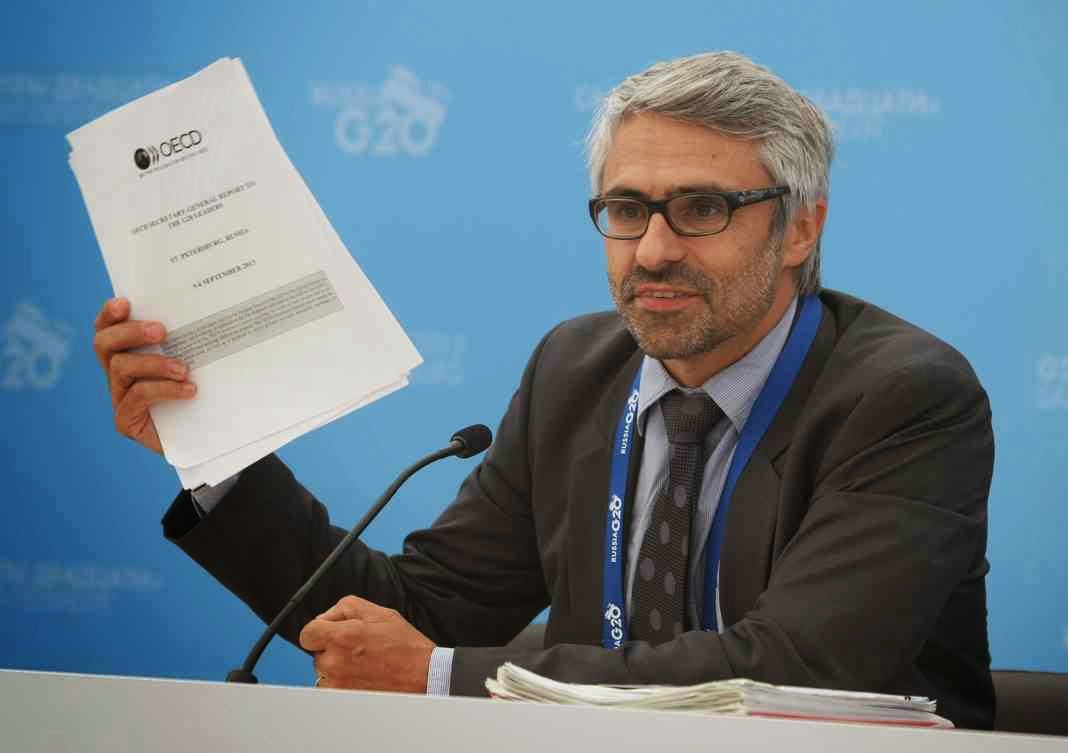
OECD tax boss Pascal Saint-Amans
For non-native speakers of English: blinkers are equipment that stops horses from seeing behind and to the side.

This month the OECD hosted a public consultation on Transfer Pricing, a first opportunity to evaluate its widely watched project to reform international rules for taxing multinational corporations.
The overall project, for which the OECD has coined the bland phrase `base erosion and profit shifting’ (BEPS,) is the fruit of a request from G20 world leaders in July 2012 to work out ways of dealing with the problems of taxing transnational corporations. A year later, its tax experts presented an Action Plan, which aims to produce proposals between now and December 2015.

The recent public consultation, on 12th-13th November, was a depressing event for us, dominated by special pleading by corporate tax advisers.

Anyone who doubts this can check out the video.

Amid all the noise about the BEPS project, however, it is worth bearing in mind that the OECD, a club of rich countries, is not the only show in town. 

The United Nations Tax Committee at its annual meeting last month decided to set up a subcommittee on BEPS, which will feed the views of developing countries in to the OECD project, and also consider other approaches to the problem that may be more appropriate for those countries. The International Monetary Fund last June approved an expanded research programme for its Tax Policy Division, which includes consideration of new approaches, such as unitary taxation. This is also the focus of a research programme of the International Centre for Tax and Development, based at the Institute for Development Studies.

The BEPS Mandate and the OECD Action Plan

Although G20 leaders endorsed the OECD’s Action Plan in the St Petersburg Declaration in September 2013, they did so in specific terms. The Tax Annex of that Declaration is worth close examination. It states firmly that
"International tax rules, which date back to the 1920’s, have not kept pace with the changing business environment, including the growing importance of intangibles and the digital economy."
Its stated aim is that
"The existing international tax rules on tax treaties, permanent establishment, and transfer pricing will be examined to ensure that profits are taxed where economic activities occur and value is created."
So the OECD’s project can and should be judged by whether its proposals actually achieve this outcome.

TJN and other civil society organizations concerned with tax justice have sponsored a BEPS Monitoring Group of tax experts, who will produce reports both commenting on OECD proposals and exploring other options and approaches.

Breaking into the Cosy Club

The OECD’s work is being done by national tax officials through the OECD’s Committee on Fiscal Affairs and its Working Parties. These Working Parties are responsible – working in close consultation with business tax advisers – for having developed the present rules which can now clearly be seen to be dysfunctional. We may doubt whether they can generate the `out of the box’ thinking which the OECD’s own interim report on BEPS in February 2013 said was needed. Many tax advisers are former national and OECD officials, which creates a cosy club culture.

A handful of civil society representatives attended the public consultation on November 12th and 13th, which was a novelty for all concerned. It was hard not to feel like gatecrashers at a private party. We managed to have our say, but this club has spent years crafting the current rules, and they are naturally reluctant to rethink them.

The non-OECD states from the G20 are now participating, nominally on an equal basis. Yet even the larger developing countries do not have the resources to make a major input into the dozens of meetings which are already planned. China, India and South Africa each sent only one expert to the consultation and for the 2-week meeting of Working Party 6 which followed; Brazil had only a diplomat from the embassy with a watching brief, while the main OECD countries sent four or five specialists each.

Overwhelmingly the participation was of corporate tax advisers, mainly from the accounting and law firms, who earn large sums from the complexities of the current system and the encouragement it provides for tax avoidance. Unsurprisingly, their contributions aimed mainly at trying to continue business as usual. The in-house corporate tax advisers were more realistic and astute, but also cautious. The large firms for which they work spend large sums on tax `planning’: more than they actually pay in tax in many countries. They understand the faults with the present system but are unlikely to argue for changes which would mean that their firms might pay more tax, and many of them would lose their jobs. Turkeys, after all, don’t usually vote for Christmas.

The Digital Economy and the faulty “Permanent Establishment” Concept

Here is an example that illustrates how reform might go awry.

The OECD decided ten years ago that a website should not be treated as giving a company a taxable presence in a country. This was based on the old tax treaty concept of the `Permanent Establishment’ (PE), which assumes that a physical presence is needed to do business in a country. This 20th century concept is no longer appropriate for the digital economy, and has allowed dozens of internet companies to attribute large profits to sales affiliates in low-tax countries. The G20 asked the OECD to `develop changes to the definition of the permanent establishment’ to deal with this. But so far the work seems limited to `artificial avoidance of the PE status’. On October 22nd the OECD asked for comments on this, allowing only three weeks for responses.

It should be clear that such timid steps are inadequate to deal with the challenges to international tax rules posed by the digital economy. Although the very first point in the OECD’s Action Plan concerns this issue – it aims only to study it and produce a report.

Real reforms, via the OECD’s planned route, will be hard. On this particular issue, the United States, which is home to many of those internet companies in question, has very different views than others such as France or India about how taxing rights should be allocated between countries in the global digital economy. So the OECD is unlikely to reach a clear consensus.

But unless the OECD comes up with effective solutions, many states will adopt their own measures. The EU is also getting into this act, and the European Commission is setting up an Expert Group on the Digital Economy which will also report, at much the same time as the OECD does.

Country by Country Reporting

Perhaps the most important mandate from the G20 is to develop `a common template for companies to report to tax administrations on their worldwide allocation of profits and tax’. Country-by-country reporting has of course been a long-standing demand of the tax justice movement, not only for tax purposes. Its acceptance by the G20 has the potential to transform the taxation of TNCs. It could for the first time enable tax authorities to check on avoidance, by giving them a picture of the firm as a whole, and data on its employees, physical assets and taxes paid and due in each country. A submission written by Richard Murphy for the BEPS Monitoring Group outlines our position, and Richard presented it at the consultation.

The tax advisers at the OECD consultation, of course, tried to restrict the scope of information that could be supplied, with the usual pleas that it would cost too much to collect and compile, or it could breach commercial confidentiality. Apparently, even data on employee numbers are sensitive! Yet even such minimal information they thought should be confidential, except to tax authorities. Indeed, many argued that it should be supplied only to the TNC’s home country tax authority, and shared with others only subject to safeguards. This ignores the simple fact that any country can legislate to require reporting of this type of information. Also, once such a report is delivered to any tax authority others can request it if they are parties to the Multilateral Convention on Administrative Assistance in Tax Matters, which is now open to all, and which the OECD is encouraging states to join.

Transfer Pricing and Intangibles

Most time at the Consultation was taken on transfer pricing of intangibles: mainly intellectual property rights. This has always been the most difficult area, since many tax avoidance strategies involve transferring notional ownership of such rights to affiliates in low-tax countries.

We think the OECD’s entire Transfer Pricing Guidelines should be reconsidered from top to bottom - especially the chapter on Intangibles - in the light of BEPS. The Guidelines have been revised bit by bit over the years, and are now just a hodge-podge, providing no clear guidance at all. They are like a biblical text: support can be found in them for widely different and even opposing viewpoints.

They are especially incoherent because the OECD has refused to face up to the central contradiction in the international tax rules. The model tax treaty articles devised in 1928, and still little changed, were designed for an era of international lending, assuming that an investor in one country would be lending to a business in another. This principle was adapted for transnational corporations (TNCs) by saying they should be treated for tax purposes as if their affiliates in each country were separate and independent entities, dealing at `arm’s length’ with each other. In reality of course TNCs are centrally directed and globally integrated firms, rather than collections of loosely connected separate entities. This separate entity/arm’s length principle at the heart of OECD transfer pricing rules allows, and indeed encourages, TNCs to set up entities in no or low-tax countries to avoid tax.

When the OECD adopted the Transfer Pricing Guidelines over 30 years ago they tried to apply the arm’s length principle by saying that the accounts of related entities within a TNC group should be adjusted by pricing transactions between them on the basis of `comparables’.

In economic reality, however, such firms exist because of the benefits and synergy resulting from integration, frequently because they can develop unique intangibles by spreading the costs and exploiting global markets. So tax authorities in the real world can rarely find true comparables for the goods or services transferred within an integrated firm. Historically, tax authorities dealt with this by using comparable profit methods, adding a mark-up to production costs or applying a margin on sales by reference to similar local firms.

The Guidelines were modified in 1995 to try to deal with this, by introducing two new methods for estimating profits. The `transactional net margin method’ (TNMM) is another type of comparable profit method, based on analyzing the functions performed by the affiliate. Finally, they accepted the `profit-split’ method. This aggregates the profits of the relevant related entities, and apportions them on the basis of suitable `allocation keys’. (See our paper, Towards Unitary Taxation, for more details on what these terms mean.)

But since this involves combining the profits of related firms and apportioning them out to the relevant jurisdictions where they do business, according to genuine economic substance – it is in effect a unitary approach!

But the OECD will not acknowledge this, instead preferring to use weasel words and phrases to wriggle out of ever conceding that there might be something to unitary taxation. The OECD treats these methods as compatible with its Arm’s Length method, and confusingly describes them as `transactional profit methods’. They are considered to be different from `formulary apportionment’, which is firmly rejected by the Guidelines, but is narrowly defined as apportionment by a `formula fixed in advance’.

The revised draft on Intangibles discussed at the consultation would inevitably lead to greater use of the profit split method. But as the submission by our BEPS Monitoring Group points out, it fails to make that clear and uses ambiguous and contradictory language. In our view, the profit split method should be put on a sounder basis, with clearer guidance on how to aggregate or consolidate the profits, and the choice of allocation keys.

There was a clear reluctance at the consultation to accept such rethinking. The more likely outcome will be the addition of a possible alternative approach for use in `special circumstances’, which would probably be narrowly defined.

The BEPS Action Plan even hinted that this may entail using methods outside the arm’s length principle. We wait to see what may come of this. Our concern is that adding yet another method would only sow further confusion and potential conflict. Much better would be a rewrite of the Guidelines to remove the double-talk about the arm’s length principle, and accept that it is possible and desirable to build on the profit split method to move towards a unitary approach to taxation of TNCs.

Update 2014: for recent news on corporate tax see here.

0 comments

Wednesday, July 17, 2013

Tax Justice Briefing: on the OECD's forthcoming report on corporate tax

TJN today has produced a new briefing to serve as a curtain-raiser ahead of the OECD's planned launch on Friday of a long-awaited report that is supposed to offer new solutions to the problems of taxing multinational corporations.

This blog contains a summary of the TJN report. The full report is available here.

Summary: TJN briefing on the OECD's "BEPS" project on corporate tax avoidance

On Friday 19th July the OECD will publish its long-awaited Action Plan on how to fix the broken international tax system for multinational corporations. An interim report on this project, called “Base Erosion and Profit Shifting (BEPS,)” was published in February with a promise of “holistic and comprehensive” solutions to the problems of taxing multinationals.

We do not, however, expect the OECD to announce any radical new approach on Friday.

What we expect, instead, is a series of piecemeal recommendations for states to apply patches to the increasingly leaky international tax system. The effect would be like trying to plug the holes in a sieve.

The problem, in a nutshell

The OECD plays a co-ordinating role in the international tax system by bringing together national tax officials from rich developed countries, and they have designed international tax rules that many states choose to follow to a greater or lesser degree. But its recommendations are not binding on states. To the extent that the OECD does recommend meaningful changes, all the evidence suggests that these will be a piecemeal patch-up job. They will also face determined opposition from the tax avoidance industry and big business in countries such as the UK, US, Netherlands and Ireland, which have provided special tax breaks and regimes in recent years, in response to such lobbying and pressure by multinationals and their advisers.

Let’s now suppose, however, that the OECD does succeed in persuading governments to row back on their current strategies and strengthen current tax rules. At best, the OECD can only provide loose coordination of the rules. Its piecemeal strategy outlined so far in the BEPS project would result in governments trying to grab what they can of the various parts of the profit of transnational corporations. Conflicts already abound in the current system, and success on BEPS' terms would lead to intensified international tax conflict. A patch-up job, even if the OECD were to achieve its objectives, cannot deal with the fundamental flaws in the current system.

The Solution

Most tax experts agree that a better approach to taxing multinational corporations requires a fundamental philosophical shift in the underpinnings of the international tax system, away from the current approaches, where multinationals are taxed according to convoluted legal forms devised by their accountants and lawyers, towards a system where they are taxed according to the genuine economic substance of what they do and where they do it.

This alternative is to take a Unitary approach to taxing multinational firms. This involves taking a multinational’s total global profits and apportioning them out between the states where it does business according to its genuine economic presence in each country.

Many people, including some experts at the OECD, accept that such a system is desirable. Yet they are refusing, so far, even to investigate it, because they claim that it would be too difficult to obtain global agreement on such a new approach. Another reason, perhaps, is because it would be, as one top U.S. tax expert put it recently, “too effective” – and the tax shock would therefore be too great for multinationals to accept.

But the naysayers are quite wrong. A unitary system can be introduced gradually, in a series of steps, building on elements in the current system. The first step would be merely a transparency requirement, to help countries see and understand the genuine economic substance of what multinationals do and where they do it. Second, apportionment of the total profits could be done by building on so-called “profit-split” methodologies (explained in the main report), which are already accepted in some circumstances. Third, there should be a procedure for resolving disagreements, which could also be based on existing arrangements, although these also should be more transparent.

Setting out on the road towards a unitary approach is not only far more desirable than merely applying sticking plasters to the current system, but it should also be more politically feasible, if governments really want to ensure an effective system.

All the OECD needs to do now is to crack open the door to serious study of this reform, which is the only effective way that we will be able to tax multinational corporations properly in our globalised world.

The full briefing explores this in greater detail.
Media enquiries

Please contact Professor Sol Picciotto:
Skype: Sol.picciotto
email: s.picciotto@lancs.ac.uk
Phone +34-943-579800

0 comments

Wednesday, September 18, 2013

How serious is the OECD about mending the system for taxing multinational corporations?

Professor Sol Picciotto, a Senior Adviser to TJN, has an article published in the esteemed U.S. publication Tax Analysts, entitled Can the OECD Mend the International Tax System? It looks at the OECD's much-hyped Base Erosion and Profit Shifting (BEPS) project, which admits that the international tax system it helped design is fatally flawed, and proposes to redesign it. The OECD bills this project as no less than ‘‘a turning point in the history of international co-operation on taxation.’’ And, as Picciotto notes, the BEPS project aims"
"to remodel the international tax system to ensure that TNCs are taxed according to where they actually do business. This is a major shift of perspective for the OECD: For decades it has prioritized the prevention of double taxation, but only recently has it begun to talk about the problem of double nontaxation."
This is a significant shift, and we at TJN like to think that we have been contributors to this global shift in attention. However, one of the big questions we have asked before is whether the OECD is serious - really serious - about reform here. Picciotto's new article notes:
The BEPS action plan entails taking a new look at most of the key elements of the international tax system concerning TNCs. To keep the project within some sort of bounds, the report states that it does not aim to reconsider the basic allocation of taxation rights between residence and source countries, although some countries consider that this is needed. Nevertheless, the actions envisaged would, if taken seriously, involve significant changes, indeed some reversals, of countries’ tax policies, and of the positions taken by the OECD itself. The exercise can be likened to disassembling a malfunctioning machine, refashioning the parts, and then putting them back together in the hope that it will work better.
This article looks first at the parts identified by the report as in need of repair, then at the reassembly methods proposed, and concludes by assessing whether and how the renovated machine might work.

Under a sub-heading entitled Will it Work?, Picciotto notes that
In opting for repair rather than a redesign, the OECD has taken on a difficult task. It will have to surmount significant political obstacles as well as technical difficulties to come up with effective measures under the various actions in the plan, as well as coordinating the overall reform.

There are of course many who have argued that it is time to abandon the separate entity/ arm’s-length principle and move toward a unitary approach to taxation of TNCs.
The OECD has cited political obstacles to unitary taxation as a reason for inaction. But Picciotto does not really buy this line of argument, for two particularly big reasons.
"The method chosen by the OECD faces equivalent difficulties. The difference is that its preferred part-by-part repair of the existing system will mean tackling a series of political obstacles over a period of time, instead of the more direct confrontation that a comprehensive reform would require. It is possible that this salami-slicing approach will be easier, but the danger is that it may lead to drawn-out debates over detailed technical issues, resulting in a series of watered-down compromises. There are doubtless many who will hope that the spotlight of political attention will move to other issues, and perhaps even that economic growth will return and fiscal pressures abate, so that the project gradually dissipates into ineffectiveness.

The bigger question, however, is whether even a serious and sustained repair effort can result in a functioning system. The power of the argument for a unitary approach is that it would provide a more sound foundation for the international tax system."
More on unitary taxation here. If the OECD won't move forwards on examining it, others certainly will be doing so.

Full citation: Picciotto, S (2013) Can the OECD Mend the International Tax System? Tax Notes International 71: 1105-1115


0 comments

Monday, September 02, 2013

Fixing the cracks in corporate tax: new policy brief

The Tax Justice Network and 33 other non-governmental organisations have just released a new policy brief responding to the OECD's large and widely reported Action Plan on "Base Erosion and Profit Shifting (BEPS) by multinational companies," (otherwise known as corporate tax dodging.)

Our new report is entitled Fixing the Cracks in Tax: A Joint Plan of Action.

As it states, and as we have stated before:
"The international system for the taxation of TNCs is no longer fit for purpose.  International tax rules, drawn up 80 years ago, have not kept pace with the changing business environment."
This new report, also available from here and here, issues a range of recommendations to the OECD and the G20, with three key pillars:
  • Take effective steps to ensure that developing countries can participate in the BEPS process on  an equal footing, and assist them in implementing measures to stem their losses from international tax avoidance that deprives governments of badly needed revenues.
     
  • Undertake – jointly with other organisations, policy makers from developing and developed countries, and independent experts – a rigorous study of the merits, risks and feasibility of more fundamental alternatives to the current international tax system, such as unitary taxation, with special emphasis on the likely impact of these alternatives on developing countries.
  • Implement additional measures to tackle financial and corporate secrecy, including the requirement for TNCs to provide public combined and country-bycountry reports, the establishment of comprehensive multilateral automatic exchange of tax information, and the public disclosure of the beneficial owners of companies, foundations and trusts.
We wholeheartedly endorse and support all of these. For reasons best known to its members, the OECD has a history of viscerally, intransigently attempting to close down all discussion of unitary taxation; the BEPS report was the first time it allowed a tiny chink of an opening, when it acknowledged that measures "beyond the arm’s length principle" may be required to
deal with some of the problems it identifies.

In more fine-grained detail, the report also makes a series of other recommendations, of which we will highlight these two here:
  • The OECD and the G20 should strengthen the UN tax committee. Quite so, as we've noted before.
  • Governments must promote a shift from tax competition to global and regional tax cooperation. Read more about the evils of tax 'competition' here. 
This blog will be posted permanently on our transfer pricing page.

0 comments

Friday, September 06, 2013

The G20 leaders' statement, in relevant part

For those who haven't yet read the G20 leaders' statement today, here is the part that particularly interests us:
51. In a context of severe fiscal consolidation and social hardship, in many countries ensuring that all taxpayers pay their fair share of taxes is more than ever a priority. Tax avoidance, harmful practices and aggressive tax planning have to be tackled.

The growth of the digital economy also poses challenges for international taxation. We fully endorse the ambitious and comprehensive Action Plan – originated in the OECD – aimed at addressing base erosion and profit shifting with mechanism to enrich the Plan as appropriate. We welcome the establishment of the G20/OECD BEPS project and we encourage all interested countries to participate. Profits should be taxed where economic activities deriving the profits are performed and where value is created.

In order to minimize BEPS, we call on member countries to examine how our own domestic laws contribute to BEPS and to ensure that international and our own tax rules do not allow or encourage multinational enterprises to reduce overall taxes paid by artificially shifting profits to low-tax jurisdictions. We acknowledge that effective taxation of mobile income is one of the key challenges. We look forward to regular reporting on the development of proposals and recommendations to tackle the 15 issues identified in the Action Plan and commit to take the necessary individual and collective action with the paradigm of sovereignty taken into consideration.

51.    We commend the progress recently achieved in the area of tax transparency and we fully endorse the OECD proposal for a truly global model for multilateral and bilateral automatic exchange of information. Calling on all other jurisdictions to join us by the earliest possible date, we are committed to automatic exchange of information as the new global standard, which must ensure confidentiality and the proper use of information exchanged, and we fully support the OECD work with G20 countries aimed at presenting such a new single global standard for automatic exchange of information by February 2014 and to finalizing technical modalities of effective automatic exchange by mid-2014.

In parallel, we expect to begin to exchange information automatically on tax matters among G20 members by the end of 2015. We call on all countries to join the Multilateral Convention on Mutual Administrative Assistance in Tax Matters without further delay. We look forward to the practical and full implementation of the new standard on a global scale. We encourage the Global Forum to complete the allocation of comprehensive country ratings regarding the effective implementation of information exchange upon request and ensure that the implementation of the standards are monitored on a continuous basis. We urge all jurisdictions to address the Global Forum recommendations in particular those 14 that have not yet moved to Phase 2. We invite the Global Forum to draw on the work of the FATF with respect to beneficial ownership. We also ask the Global Forum to establish a mechanism to monitor and review the implementation of the new global standard on automatic exchange of information.

52.    Developing countries should be able to reap the benefits of a more transparent international tax system, and to enhance their revenue capacity, as mobilizing domestic resources is critical to financing development. We recognize the importance of all countries benefitting from greater tax information exchange. We are committed to make automatic exchange of information attainable by all countries, including LICs, and will seek to provide capacity building support to them. We call on the Development Working Group in conjunction with the Finance Track, to work with the OECD, the Global Forum and other IOs to develop a roadmap showing how developing countries can overcome obstacles to participation in the emerging new standard in automatic exchange of information, and to assist them in meeting the standard in accordance with the action envisaged in the St Petersburg Development Outlook. The Working Group should report back by our next meeting.

Working with international organizations, we will continue to share our expertise, help build capacity, and engage in long-term partnership programmes to secure success. In this respect, we welcome the OECD Tax Inspectors without Borders initiative, which aims to share knowledge and increase domestic capacities in developing countries in the tax area. Finally, we are committed to continue to assist developing countries, including through the IOs, in identifying individual country needs and building capacity in the area of tax administration (in addition to automatic exchange of information) and encourage such support to be developing country led.
With tax annex here.

Reminder: we have commented on the G20 process already today, here.

Overall summary: this is rather short on specifics, and falls far short of some of the recommendations we have made (such as this one), but we have come a long way from even a couple of years ago. 
We are, of course, delighted to see official support for the Tax Inspectors Without Borders initiative, which is a proposal that TJN put to a government conference in Bonn, Germany, in 2011, and which rapidly found political support from a wide range of countries. 

0 comments

Monday, June 17, 2013

Corporate taxation: are the OECD technocrats serious?

Guest blog by Prof. Sol Picciotto:
Pascal St-Amans, head of the OECD’s Centre for Tax Policy and Administration, has been travelling the world reporting on the progress of the OECD’s Base Erosion and Profit Shifting (BEPS) project. This is an OECD initiative responding to justified outrage around the world about the international tax system, which is unfit for the modern age and allows multinational corporations to take the benefits from societies in which they operate, then skip paying their share. The OECD, a club of rich countries which has dominated the design of the international tax system, bears the greatest responsibility for the current mess. Recently U.S. tax expert Lee Sheppard, for instance, described the OECD-designed tax treaty system as `a load of nonsense . . . to make life comfortable for multinationals’.

Last Tuesday 11th June St Amans was in London, giving evidence to the House of Lords Committee on Economic Affairs, which is considering whether a new approach is needed to corporate taxation. Thursday 13th he was in Washington, speaking to the tax-writing committee of the US Congress, the House Ways & Means Committee.

There’s a lot riding on the BEPS project. Politicians are under enormous pressure from their citizens, fed up with facing austerity, while hearing the many media revelations of avoidance of billions of dollars of taxes by the world’s largest and until now most respected companies: Amazon, Google, Ikea, Starbucks, Vodafone. So the G20 leaders ordered the OECD to come up with effective measures. The OECD’s interim response in February looked serious. It promised to think `outside the box’, and seek `holistic and comprehensive solutions’. TJN, along with 57 allies, greeted this with cautious optimism, and we subsequently gave detailed responses to questions sent to us by the OECD.

Now the OECD is working on the report which is supposed to lay out its proposed Action Plan for reform of the international tax system. This was due to be published later this month, but we now understand that it may not be ready until mid-July. Well, Rome was not built in a day, and we can understand if they are finding it hard with a few weeks’ work to agree on how to turn the juggernaut of the OECD consensus on tax onto a new course.
Pascal of course, like his colleagues, is a technocrat. This is not meant pejoratively - they are experts, specialists on the international tax system. They have an important job: to advise governments, and to produce reports which can help ensure that there is a well-informed public sphere for debate and decision-making on complex issues.  
But Pascal seems to have stepped outside this role. In his oral evidence to the House of Lords committee, he was asked about Unitary Taxation as a possible approach to taxation of transnational corporations (TNCs). His response was very negative, indeed dismissive. He argued that this `would require that all jurisdictions across the world - and we have 190-plus states, plus jurisdictions which are tax-sovereign - to agree on criteria and trust each other enough to rely on the information on the consolidated accounts which will be held in the headquarters of the group. I just don't see this happening any time soon.’
St Amans knows very well that is mistaken, and for several reasons. Agreement from every jurisdiction in the world is simply not necessary. The more co-operation, the better, of course: but there are several possible full, partial and even unilateral versions of unitary tax, and routes for a transition to such a system. International tax is a process of coordination, not a straight-jacket.

St Amans also knows that many international tax experts strongly believe that the only way effectively to reform the system of TNC taxation is precisely to move towards treating TNCs as what they are, unitary firms – rather than the current system that treats them as loose collections of separate entities all trading with each other as if in a competitive market.

For example, Prof. Ed Kleinbard, who also gave evidence at the same House Committee session as St. Amans, proposed that the US should adopt – on a unilateral basis – a worldwide approach to assessment of TNC profits, with a credit for foreign taxes paid.  
Others have made proposals for a transition towards a unitary taxation approach by extending current transfer pricing rules, especially the profit-split method (see my paper Towards Unitary Taxation for an explanation of this, Box 3.) This was put forward five years ago in a paper by Reuven Avi-Yonah, Kim Clausing and Michael Durst, who are also now part of a team of researchers working on the implications of unitary taxation for the International Centre on Tax and Development.  
St. Amans should know better, not least because the response to BEPS by TJN and its allies clearly put forward proposals for a transitional strategy. We hope that he and his colleagues are taking it seriously, despite his casual remarks to their Lordships.
What we are now looking for from the OECD is a serious report that lays out the possible options, so that a genuine public debate can take place. It is not the role of technocrats to foreclose that debate. They should accept that the proposals for moving towards a unitary approach for TNC taxation deserve a hearing. We believe, indeed, that many OECD experts – even Pascal – accept that a unitary approach is conceptually the best one. In that case, it is not for them to say what is or is not politically feasible. So why is he opposing it? 
Ways can be found to move towards a unitary approach in a gradual and pragmatic way. It clearly cannot be done overnight, but should be put on the table as an option now. Interim measures are also desirable and possible, which can and should be designed to move the system towards a unitary approach. But to dismiss such ideas as politically not feasible would be a breach of the responsibility that technocrats owe to the public.


0 comments

Monday, March 18, 2013

OECD Enables Companies to Avoid $100 Billion in Taxes

That's not our headline, but Bloomberg's, at the top of a blistering and important story about the OECD, the club of rich countries that has for decades been responsible for setting the rules and guidelines for the world's international tax system.
"OECD officials “have been digging themselves deeper and deeper into a hole by blindly pursuing a mistaken approach that allows multinationals to avoid taxes,” said Sol Picciotto, an emeritus professor of law at Lancaster University in the U.K."
(Picciotto is a senior adviser to TJN,  and author of a report on unitary taxation that we published a few weeks ago.) The story by the indefatigable Jesse Drucker looks at many things, but one of the most important is the close, even incestuous relationship between the OECD, a quasi-governmental body, and the industry that is making billions out of the broken international tax system, "whose basic structures were devised a century ago," Picciotto's report said.
"The organization has long enjoyed a close relationship with industry. Its three top tax officials left in 2011 and 2012 to join firms that help companies avoid taxes by taking advantage of laws to move profits to locations such as Bermuda and Mauritius."
The revolving door is not limited to the OECD: it happens between Big Four accountancy firms and national governments the world over - but this is a particularly important one to note. And get this:
"While its 34 member nations -- primarily the U.S., Japan and European countries -- underwrite the OECD’s $460 million annual budget, tax-planning firms that advise multinational companies have contributed hundreds of thousands of dollars to sponsor its conferences."
With all this money at their disposal, they still have to compromise themselves financially in this way. It is all a rather shocking state of affairs. It is hardly surprising that our report noted:
"Although many experts do oppose unitary taxation, typically this is for reasons that do not withstand serious scrutiny, and which are largely due to vested interests in the present system. . . the complexity of the current system is highly lucrative for the large tax advice and tax avoidance industry including the Big Four accounting firms, and they naturally prefer to keep what they have."
The Bloomberg article does note that the OECD has recently shown its first signs of willingness to consider serious, deep-rooted reforms, and although we welcomed the spirit of openness to fresh thought in the OECD's recent BEPS (Base Erosion and Profit Shifting) project, we are under no illusions that the vested interests fighting against serious change have multiple hooks into the OECD.

And the Bloomberg story outlines one of those hooks.
"Companies are pushing back. General Electric Co. (GE) has dispatched its top international tax official to lead an effort to change the OECD’s proposed guidelines on mailbox subsidiaries. In November, the OECD hosted public hearings in Paris, where one corporate tax representative after another objected to the plans."
It quotes  Daniel Frisch, an economist at Horst Frisch Inc. in Washington: succinctly stating what we already know:
“Industry successfully leans on the OECD." 
It's also worth noting that blacklists can be useful when trying to figure out how to tackle tax havens. But these blacklists, of course, get gamed by OECD member states, who don't like being on the blacklists and have the political power to get themselves off. So, for example, this commentary by Jane Gravelle of the U.S. Congressional Research Service (CRS) notes:
 "The Organisation for Economic Cooperation and Development (2000) created an initial list of tax havens. . . .The OECD excluded some low-tax jurisdictions thought by many to be tax havens, such as Ireland and Switzerland."
The OECD later emphasised a black, white and gray list system for tax havens, focusing on their secrecy. Look at the latest version, from December 2012. The blacklist is entirely empty. And the gray list contains  . . . the financial giant of Nauru, and nobody else. All the other tax havens are clean!

On the positive side, street-level pressure in many OECD countries appears to be having results, and the possibility of real change now exists for the first time, not just with the OECD's BEPS project for corporate taxation, but also on secrecy, where the OECD has finally (after a lot of prodding) accepted that its next-to-useless system of 'on request' information exchange might not be quite so good as the far better alternative, automatic information exchange.

But progress will only be sustained if the street-level protesters, journalists, non-governmental organisations and other representatives of ordinary taxpaying citizens keep holding their feet, and their indivial governments' feet, and the companies' feet, to the fire.

Update: more on this from Richard Murphy, here.

0 comments

Friday, September 06, 2013

OECD and G20: How Long Will it Take on Tax?

Update: the G20 statement is now available.

The OECD has reported to today’s G20 Leaders meeting in St Petersburg on its tax work. This now falls into three areas, covering two issues.

First, transparency and exchange of information on tax. We should remember that this resulted from a much earlier initiative by the then G7, when Russia was still waiting in the wings and the developing countries such as the BRICS were not even candidates to be considered leading states.

The concerns at that time about tax havens and the offshore secrecy system led the G7 to ask for an OECD initiative, and the result was its report in 1998 on Harmful Tax Competition.  This project was of course effectively derailed by a change in US policy, when the new Bush administration accepted arguments that the initiative as first formulated entailed dictating tax policy to other states. The project then refocused on obtaining information from tax havens, laboriously pursued by the OECD for nearly a decade by negotiation of bilateral tax information exchange agreements (TIEAs). Only now, after the fiscal crisis of 2007-8, has this effort for fiscal transparency produced the commitment at this year’s G8 summit meeting in Lough Erne to establish a new global standard of automatic exchange of tax information, as well as transparency of beneficial ownership. Yet this is what organisations like TJN called for from the start. Until recently, we were laughed at: now it is mainstream.

So the OECD now has two transparency projects. The first, based on bilateral agreements for exchange of information on request, is coordinated through the so-called Global Forum on Transparency and Exchange of Information for Tax Purposes, which conducts `peer reviews’ on each country. Second, the new standard which has finally been proclaimed is for multilateral automatic exchange of information. The OECD now aims to develop a model for this to be ready next year. The key is of course establishing suitable technical systems to ensure effective use can be made of such large quantities of data that will emerge from automatic information exchange. The OECD has in fact been working on this for some 30 years, largely in secret, so it will be interesting to see what they come up with.

The third area is of course "Base Erosion and Profit Shifting" (BEPS), a project looking at corporate tax avoidance which the OECD launched quietly in July 2012, and was then given a political impetus by the G8 and the G20. After a year’s work, it published an Action Plan on  July 19th 2013. This envisages a 30-month work programme on 15 Action Points, aimed essentially at trying to repair the international tax system. We gave our immediate response to the Plan at the time, regretting that the OECD had chosen to try to repair a fundamentally flawed system that cannot be effectively fixed, and rejecting the new 21st Century approach that we think is needed. In our view, the OECD has allowed the G20 leaders to kick the can down the road, proposing a plan which will face enormous obstacles, and may prove largely ineffective. We will continue to keep a close watch, and will have much more to say as the work proceeds.

What can be learned from comparing the two initiatives? Only after 15 years’ pressure from civil society has the OECD now accepted the global standard of multilateral automatic exchange of information. We hope that it will not take quite so long for it to accept that the only effective way to take transnational corporations is to treat them as unitary firms, based on Combined and Country-by-Country reporting and profit apportionment based on their real presence in each country.

See also this policy briefing, co-signed by the Tax Justice Network and 33 other organisations, focusing on the BEPS initiative.

0 comments

Monday, October 07, 2013

Profit split: a crowbar for unitary taxation of multinational corporations

Update: see our new Transfer Pricing page here.

Marty Sullivan has an article in Tax Analysts’ Worldwide Tax Daily today, entitled “How to Prevent the Great Escape of Residual Profits” (unfortunately it’s behind a paywall at present). He picks up from a comment by TJN Senior Adviser Sol Picciotto, in his article analysing the OECD’s Base Erosion and Profit Shifting (BEPS) project, which seeks to create some fixes for the cracks (or, more accurately, the gaping chasms) in the international tax system. Sol pointed out that even in the OECD’s own work on the thorny issue of transfer pricing of intangibles such as intellectual property, that ‘‘apparently reluctantly, yet inexorably, we are led to profit split’’. (See Note 1 below for a brief explanation of what 'profit split' means.)

Sullivan then refers to a recent working paper by Brett Wells and Cym Lowell, putting forward a proposal for reforming US tax laws (which they call a “mandatory two-sided transfer pricing methodology). The authors offer their proposal as nothing less than "a straightforward and unique cure to a problem that has plagued our nation since the end of the post-World War I era."

Wells' and Lowell's approach is, essentially a profit-split method, which involves a unitary taxation approach (see note 2 for a brief explanation of unitary taxation, and its contrast with the OECD's fatally flawed 'separate entity' and 'arm's length' approach). We at TJN have explained in great detail why unitary taxation is so superior to the OECD's approach. As Picciotto explains:
"The power of the argument for a unitary approach is that it would provide a more sound foundation for the international tax system, one that matches the economic reality of TNCs as integrated firms. In contrast, the [OECD's] separate entity/arm’s-length principle cannot provide a comprehensive basis for taxation of TNCs, since it limits states to taxing their various parts."
He describes the OECD's BEPS project as one of "repair" rather than "redesign" - which is what is ultimately called for in this hopelessly flawed system.

We predict that the momentum will continue to grow for this perspective, which even the OECD will have to consider sooner or later, even if they refuse to accept the terms “formulary apportionment” or “unitary taxation”.

Note 1: Profit Split.
Under the profit-split method, the total combined profits from a transaction or transactions are split between jurisdictions based on the genuine economic activity in different jurisdictions. The split is determined by the geographical division that independent parties would expect to realise from
those transactions. This is not full-blooded unitary taxation, but it is potentially a building block for it.

Note 2: Unitary taxation.
The present international tax system treats transnational corporations (TNCs) as if they were loose collections of separate entities operating in different countries, with each part transacting with the others supposedly at an 'arm's length' price as if they were independent entities operating in a free market - which plainly they are not. There is currently only weak coordination between tax authorities, so this ‘separate entity’ approach gives TNCs tremendous scope to manipulate their internal 'transfer prices' to shift their profits around the globe to suit their tax affairs. Under unitary taxation, by contrast, they would be taxed not according to the legal forms that their tax advisers create for them, as is currently the case, but according to the genuine economic substance of what they do and where they do it. This would be far more legitimate and simpler to implement than the current system.

For more on this broad subject, see Picciotto's briefing paper, Towards Unitary Taxation of Transnational Corporations.

Update: for more on Corporate Tax see here.


0 comments

Wednesday, March 27, 2013

No More Shifty Business: a response to the OECD's BEPS report on global tax


Last month we blogged a major new initiative by the OECD, a group of rich countries, to tackle tax avoidance by multinational corporations. We have been highly critical of the OECD in the past, but we broadly welcomed the new initiative, called BEPS (Base Erosion and Profit Shifting) initiative, because it appeared to show a real potential change of direction and a new willingness to start thinking of fundamental reform to international tax for the first time.

Now a large number of civil society organisations have jointly produced a document entitled No more shifty business: A response to the OECD’s Base Erosion and Profit Shifting Report on Tax.

It notes, among other things, that the international tax rules first drawn up 80 years ago have not kept pace with the changing business environment; the current rules are not fit for purpose. TJN has been saying this for a long time, and the OECD at last appears to be recognising this truth.

Perhaps the most important section of the report is this part:
"In order for MNCs to be taxed according to their real nature, two measures should be introduced:
  • MNCs should be required to submit a worldwide combined report, including consolidated accounts, to the tax authorities of each country in which they operate.
  • MNCs should be required to provide a country-by- country breakdown of their employees, physical assets, sales, profits and taxes actually due and paid.
These two measures could be the basis of a tax system that would consider the total profits made by a MNC, rather than the profits made by any of its parts. It would then allocate these profits to the different countries in which the MNC conducts its real business, according to transparent criteria. Each country would be free to decide what tax rates to apply to their corresponding tax base.

These measures should be complemented by others in order to foster financial transparency, such as the public disclosure of the beneficial owner of companies, foundations and trusts, and the adoption of automatic information exchange as the new global standard."
We should add that combined reporting, broken down on a country-by-country basis, is at heart a transparency issue. In and of itself it does not force countries into any particular tax policies, and It merely provides them with the information that they need to help tax multinationals. Combined reporting is a central component of the more far-reaching unitary taxation, which our new report also explores in depth, and which was the subject of a recent paper on the topic by Professor Sol Picciotto, who has done much work on this.

John Christensen, director of the Tax Justice Network, said:
"This is a truly historic moment. Issues that have been off the agenda for nearly a century are now finally on the agenda. The OECD can either make history and push forward with thoroughgoing reforms, or it can pander to corporate lobbying and come up with a damp squib. The next 12 months will be crucial for establishing whether or not the OECD is up to the job of establishing a new and more just global economic order, where multinational corporations can no longer free-ride on the backs of the rest of us, channeling wealth upwards into the hands of a privileged few."
Access the full report here or on Christian Aid's website here. This is an important document, which we will add to our home page.  For further reading on combined reporting, see The Use of Combined Reporting by Nation States, by Prof. Michael McIntyre, and a presentation by McIntyre looking at how combined reporting functions in the hands of U.S. states. Read more on this blog entitled Render Unto Caesar, from the Center for Global Development. As it notes:
No less a radical firebrand than the Financial Times notes that corporate tax has become ‘a largely voluntary gesture’, which it thinks ‘scandalous’. The problem is particularly acute for developing countries.
Our new No Shifty Business report contains further reading material.

The organisations that have supported the No Shifty Business document are:
 
Action for Economic Reforms (Philippines)
African Forum and Network on Debt and Development
(AFRODAD) (Africa)
Alliance Sud – the Swiss Alliance of Development
Organisations (Switzerland)
Attac Norway
Australian Education Union (Australia)
Berne Declaration (Switzerland)
Canadian Council for International Co-operation (CCIC)
(Canada)
Canadians for Tax Fairness (Canada)
Catholic Bishops’ Organisation for Development
Cooperation – Misereor (Germany)
CCFD – Terre Solidaire (France)
Centre for Budget and Governance Accountability (India)
Centre for Social Concern (CFSC) (Malawi)
Centre National de Coopération au Développement,
CNCD –11.11.11 (Belgium)
Centro Internacional para Investigaciones en Derechos
Humanos (CIIDH) (Guatemala)
Ciase (Colombia)
Christian Aid (UK)
Decidamos (Paraguay)
Economic Justice Network (South Africa)
European Network on Debt and Development (Eurodad)
(Europe)
Finnwatch (Finland)
Forum Solidaridad – Peru
Global Policy Forum Europe (Germany)
Halifax Initiative (Canada)
IBIS (Denmark)
Inter Pares (Canada)
International Alliance of Catholic Development
Organisations (CIDSE) (International)
Jubilee – Australia
Kairos (Europe)
Lantidadd (America Latina)
Malawi Economic Justice Network (MEJN) (Malawi)
Methodist Tax Justice Network
National Taxpayers Association (NTA) (Kenya)
Netzwerk Steuergerechtigkeit (Germany)
New Rules (USA)
Norwegian Church Aid (Norway)
Perkumpulan Prakarsa (Indonesia)
Plateforme Paradis Fiscaux et Judiciaire (France)
Red Jubileo – Peru
Red Nicaragüense de Comercio Comunitario (RENICC)
(Nicaragua)
Sherpa (France)
SJ Around the Bay (Australia)
Social Justice (Ivory Coast)
Southern and Eastern African Trade Information and
Negotiations Institute (SEATINI) (Africa)
Secours Catholique – Caritas (France)
Spire (Norway)
Tax Justice Network
Tax Justice Network – Africa
Tax Justice Network – Australia
Tax Justice Network – Europe
Tax Justice Network – Germany
Tax Justice Network – Israel
Tax Justice Network – Netherlands
Tax Justice Network – Norway
Tax Justice Network – USA
Taxpayers Against Poverty (UK)
Union Aid Abroad – APHEDA (Australia)
Uniting Church in Australia, Synod of Victoria and
Tasmania (Australia)
Weltwirtschaft, Ökologie & Entwicklung (WEED)

0 comments

Monday, November 25, 2013

Links Nov 25

Latest OECD Compliance ratings: what the media in non-compliant countries are saying Financial Secrecy Media Monitor
See also our recent blog Is the OECD's new tax haven report a whitewash? No, but . . .

EU Seeks to Force Firms to Pay Tax on Hybrid-Loan Payments Bloomberg

Taxing times for Singapore as corporate strategy faces scrutiny Reuters

Malaysia: Tax evasion is an act of treason New Straits Times

Tax base erosion major concern for India, China tax authorities The Economic Times
See more on the BEPS Mandate and the OECD Action Plan here.

U.S.: Senate Finance Committee Chairman Max Baucus' Proposal for International Tax Reform TJN-USA
A link to several resources on the International Tax Reform Proposal

Ireland should help tackle scourge of tax dodging The Irish Times
"The Coalition has no plans to introduce a public register of true owners of companies"

"According to figures from the Swiss National Bank, tax evasion is prospering" Le Temps (In French)
Hat tip: Bruno Gurtner. On a book published by Economist Gabriel Zucman. See also our recent blog Gabriel Zucman on tax havens: "It is as if Earth was partly owned by the planet Mars.".

Hedge Funds: Turning ‘Private’ The New Game In Town ValueWalk
"Are hedge funds dodging the Dodd-Frank?"

End the 1 percent’s free ride: Taxing land would solve America’s biggest problems Salon

Money laundering is the perfect crime. It is almost impossible to detect laSexta (In Spanish)

The UK’s tax havens are coming to London War on Want
Take action now and email the Foreign Office to demand they act to abolish the UK’s network of tax havens. See also Activists and MPs take on City’s influence on Parliament The Independent

MPs must ask stock exchange regulator why it failed to act on ENRC Global Witness
See also: Curious tale of the central Asian oligarchs and the City of London The Guardian, and Top UK estate agent: top end of housing market is in a slump Treasure Islands Blog

Here is our best approximation of where the world’s tax havens are Quartz

European apathy spells end for corporate social responsibility rules The Guardian

Representation Without Taxation - The Loopy Tax Strategies Of Google, Facebook, Apple, Amazon Silicon Valley Watcher

LinkedIn goes 'unlimited' to keep accounts private Independent.ie

0 comments

Tuesday, July 30, 2013

Links Jul 30

Most of TJN's bloggers are currently away, so posting will be relatively limited for the time being.

G20 finance ministers: frenetic activity, little progress Eurodad

OECD avoidance plan is no quick fix accountingweb
See also OECD BEPS report confirms the international tax system is failing rich and poor nations Africa Business. For TJN press release see here.

Africa: Hi-Tech Action to Stop Capital Flows allAfrica / Trustmedia

Nigeria: Govt Targets Off-Shore Tax Evasion allAfrica / Trustmedia

6 Reasons Why Top Australian Companies Have Set Up Shop In Singapore Business Insider Australia

Latvia: the Next Cyprus? The National Interest
See also Latvia: Here comes the "Luxembourg of the poor"? negocios (in Portuguese), and recent TJN blog post Latvia: an emerging European tax haven

First Tax Haven in Armenia Launched Asbarez

"Black Money" Flows- Time for Global Action The Pioneer

Despite Jersey’s claims the OECD has not congratulated Jersey on its tax transparency Tax Research UK

U.S. Taxes on Overseas Earnings and the Race to the Bottom Wall Street Journal
Letter from TJN-USA's Nicole Tichon in response to recent editorial.

U.S. companies & offshore tax shelters Muckety - Mapping connections of the rich, famous & influential
How widespread are foreign tax dodges by America’s biggest companies? See the interactive map - great graphic.

Nike’s Bermuda Connection Highlighted Bernews

U.S.:Shedding Light on Advance Pricing Agreements Huffington Post

Transfer price tax risk ‘a priority’ for companies Business Day Live

Exporters mispricing goods to stash away dollars overseas The Economic Times

Ministers accused of money laundering in Mauritius Newstime Africa

Vatican confirms deal on bank information with Italy Reuters
See also: Italy and Vatican Sign Tax Agreement Taxation - International News and Information

Italian ministers publish incomes online in transparency drive Reuters

Swiss agree to share bank details The Sydney Morning Herald
Switzerland, has agreed on request to hand over the secret bank account details of Australians. For why "on request" is no solution, see resources here.

Here are the implications of Singapore's move to FATCA compliance Singapore Business

0 comments

Friday, January 10, 2014

The twilight of the international tax consensus

That's the headline of a provocative article by U.S. rock star tax expert Lee Sheppard, which states boldly in the opening column:
"Someone else’s multinationals are unfairly skipping out on their corporate tax obligations to OECD member and observer countries. That was the genesis of the OECD base erosion and profit-shifting project, which has produced an action plan that is designed to repair and preserve the fragile international consensus in the short run, but may end up upsetting it in the long run.

In the long run, the international consensus is dead, and everyone knows it, but BEPS has to be tried and allowed to fail first."
Fiery stuff, and almost certainly correct. What will replace it?

Well, there is a long-running campaign to abolish the corporate tax altogether, based on particularly pathetic evidence and analysis - plus massive lobbying firepower. That can't be allowed to succeed, as a first order of priority.

What is the international consensus? Sheppard answers:

It is a century old, mostly European gentlemen’s agreement to give residence countries tax jurisdiction over income earned by their residents in source countries. Legally, the source country has the superior right to tax income earned within its borders, so the consensus required countries to agree to be deprived of tax jurisdiction.

For "residence countries" read rich, OECD countries (where multinationals are resident) and for 'source countries" read all countries where income is really earned, including developing countries. She continues:
"It has been an open secret for some time that multinationals — led by the Americans and their huge tax departments — have abused these privileges. The affected countries are no longer limited to corrupt, badly governed, resource-exporting countries. They now include European states with sophisticated tax administrations and the home governments of multinationals.

Every country is just another country to be exploited."
We could not have said it better ourselves. And then there's this:
"The United States and its overbanked crony, the United Kingdom, used the OECD as a vehicle to push their agendas. . . . The United States and Europe still think they run the world."
And to cut a long story short:
"A new consensus cannot be built until the old one dies, weakened by
impossibility of administration.

In the short run, U.S. multinationals will pay some more tax to some foreign governments, but not the U.S. government. In the long run, we already know what the outcome will be — apportionment of multinationals’ profits based on sales.
. . .
The old order has to fail completely first."
Radical stuff. Unitary taxation (profit allocation with formula apportionment) is on its way - though not just yet. We'd argue that it's worth engaging to try and improve the OECD's fatally flawed model, as an interim step before unitary comes. But, we think, we will see it in our lifetimes. We just need the OECD and others to accept that fact.

In fact, of course, it's already here: lots of places are already using it, and as Prof. Picciotto notes, it's even tacitly part of the OECD toolkit - even if their aversion to the concept is so extreme that they'd never admit it.

Update: more from Andrew Goodall on this issue just out, here.

(Update April 2014: For resources on transfer pricing, and on unitary taxation, see here.)

0 comments

Friday, September 06, 2013

Netherlands officially admits shame in being a tax haven, pledges limited reforms

Frans Weekers
We have long criticised the Netherlands for being a particularly important tax haven for multinational companies. As, increasingly, have many others in Europe, the United States, and elsewhere. We recently noted, too, how some developing countries have been kicking back at some of the abuses that have been perpetrated upon them with the help of the Netherlands and other tax havens.

We are now delighted to see a Financial Times interview Netherlands’ deputy finance minister, Frans Weekers, making an admission that his government is uncomfortable with, and perhaps even ashamed of, the Netherlands' role in this pernicious trade. The Financial Times reports:
"A proposal by the Netherlands to renegotiate its tax treaties with 23 least-developed countries marks a turning point for a country that has until now deflected accusations that it is a key player in tax avoidance by multinational corporations.

The initiative, which comes as the G20 meeting in St. Petersburg is putting tax harmonisation issues high on the agenda, is the most concrete move yet by the Netherlands to address the criticisms. Tax justice advocates say the country’s network of treaties with over 90 countries makes it a nexus for tax avoidance, allowing multinationals to reroute their profits through Dutch “letterbox companies” that do no real business in the Netherlands and exist largely for tax purposes."
This comes in the context and the spirit of today's G20 leaders' declaration, which includes a statement that:
"We call on member countries to examine how our own domestic laws contribute to BEPS [TJN: Base Erosion and Profit Shifting, OECD-speak for corporate tax dodging] and to ensure that international and our own tax rules do not allow or encourage multinational enterprises to reduce overall taxes paid by artificially shifting profits to low-tax jurisdictions."
There is, of course, far less to the Dutch plans than Weekers' words would perhaps suggest. The FT article describes an official Dutch report presented last week, which seeks to insert new anti-fraud provisions in their tax treaties with the 23 countries; will pass on information to tax authorities in developing countries; and will 'crack down' on letterbox companies with no genuine substance behind them. The article also cites our excellent Dutch NGO colleagues at SOMO as saying, among other things, that new demands for letterbox companies to have 'substance' will be too easy to comply with.

In a brief email to TJN, Lee Sheppard of Tax Analysts spoke of the Dutch
"promises to put more 'substance' in shell companies MNCs [Multinational Corporations] use. Turns out the "substance" ain't gonna be much."
(For those interested, more details on this lack of substance in the Annex below.)

Despite this disappointment in the detail -- as is so often the case with shiny-looking tax justice-styled reforms, or world leaders' statements on these kinds of issues -- the broad new public statement by the Dutch authorities is welcome. The headline announcement is politically significant, and an official admission that the tax justice movement, in the Netherlands and elsewhere, has had a point all along.

Today's blogger remembers a tax justice meeting in Amsterdam a few years ago when a top Dutch tax official gave a horribly patronising presentation, seeking to pooh-pooh a seminal report by SOMO pointing out the damage that the Netherlands was transmitting globally through these practices. But, as the FT report continues, this attitude is changing:
“Over the past 10 years the trend has been for the number of letterbox companies in the Netherlands to keep growing. I want to turn that trend around,” Mr Weekers said. “I see the Netherlands being portrayed in a bad light. I don’t want to be portrayed in a bad light.
The Dutch move stems from a government-commissioned report over the summer which, for the first time, agreed with tax-justice groups that developing countries miss out on substantial tax revenues because of their treaties with the Netherlands.”
Here is a clear and public admission by the Netherlands government that this tax haven activity is causing great harm around the world. Or, to put it more succinctly, Tax Havens Cause Poverty.

Which, of course, immediately raises the next question: why stop at 23 countries? And why stop at these limited measures?

The logic points inexorably in one direction: the Netherlands should work towards rolling up this whole sordid industry and starting to compete on the basis of genuine business activity.

We urge other nations engaged in this shameful trade - such as Ireland, Luxembourg, Switzerland, Belgium, the United Kingdom and others - to take note.

For those with a Financial Times subscription, there is a whole lot more in the FT story.

Update from SOMO, via e-mail:
"Next week there will be a Round Table, organised by the Dutch Parliament about national tax policies in order for them to gain more insights on the matter. Tax Justice Network Netherlands as well as SOMO will participate as speakers, a.k.a. spokespersons for a fair tax system."
Annex update: a Dutch correspondent sent us this commentary on the relative lack of substance, via e-mail:
"About the substance demands: the government does not propose to raise or increase the substance demands, they only want to expand the group of companies that have to comply with them. Right now, only companies applying for a tax ruling (Advance Pricing Agreement or Advance Tax Ruling) have to meet the requirements. This will change so that all companies that function as a vehicle for channeling through royalty and interest payments (so called "schakelvennootschapen" which would be literally translated into "linking companies") have to meet these requirements.

The problem is, as you already pointed out in the blog, that the substance requirements are much too easy to comply with. The government, in their reaction published last Friday, actually said that it carried out a random sample and found that most "linking companies" already comply with the requirements. Requirements include things like: at least half of board members have to live or be "officially situated" in the Netherlands, they need to have "the necessary professional knowledge to carry out their tasks", the (important) management decisions need to be taken in the Netherlands, the company needs to have an address situated in the Netherlands, and the company needs to have equity that is "fitting for the activities it carries out". 

As you can see, all requirements are fairly easy to fulfill and open for interpretation. The government, however, stated that - based on research published earlier this summer - there's no point in raising the requirements by for example asking for a number of employees, since this will lose all effect if companies find a way of hiring personnel without increasing their real economic activity. The mailbox companies indeed already do the same with recruiting board members: trust offices offer companies to find Dutch board members, which are persons that are member of numerous boards at the same time.

So the Dutch governement, by saying that they do not raise substance requirements "since that will have no effect", combined with finding that almost all companies concerned already meet the existing requirements, are seemingly taking a kind of useless measure to obligate all "linking companies"  to comply with current requirements. It seems an empty measure really." 

0 comments

Tuesday, January 07, 2014

Seminar - Tax Havens Against Development


Seminar by CNCD-11.11.11, 11.11.11 Koepel van de Vlaamse Noord-Zuidbeweging, ABVV-FGTB, ACV-CSC, EURODAD et CADTM

« Tax havens against development »

January 30th 2014
31 Rue de Trêves, 1040 Bruxelles

9h30 – Welcome and coffee

10h00-11h00 – Introduction panel
Moderator: Arnaud Zacharie, CNCD-11.11.11
Jean-Pascal Labille, Minister for Dev elopement cooperation :  Tax issues in Belgian development cooperation policy
Jesse Griffiths, Eurodad : Illicit financial flows and financing for development 
Jérémie Cravatte, CADTM : The debt crisis and tax justice

11h00-11h15 Coffee break

11h15 – 13h00 - Multinationals and their tax privileges
Moderator: Rudy De Meier, 11.11.11
- Ruth Kelly, Action Aid: the SAB Miller case in Ghana
- Anne-Sophie Simpere, Oxfam France: the Glencore Mopani in Zambia and Areva in Niger cases
-Renata Fontana, OECD Centre for Tax Policy and Administration: BEPS plan presentation
- Pierre Habbard, TUAC (Trade Union Advisory Committee to the OECD)
- Tove Maria Ryding, EURODAD

13h00 – 14h00 – Lunch

14h00 – 15h45 – Belgium external tax policy – Tax treaties for whose benefit ?
Moderator: Nicolas Van Nuffel, CNCD-11.11.11
- Katrin McGauran, SOMO : the impact of Netherland’s tax treaties on developing countries tax revenue
- Renaud Fossard, Latindad : the impact of tax treaties on Latin America’s tax revenue 
- Tove Maria Ryding, EURODAD
 - Dirk Vandermaelen : MP for the SPA and member of the Council of Europe parliamentary assembly

15h45 – 16h45 – Conclusions
- Anne Demelenne, FGTB General secretary, trade unions for international tax justice
- Marie-Hélène Ska, CSC National secretary, the issue of tax justice in Belgium 
- Bogdan Vanden Berghe, 11.11.11 : 2014 elections and the challenge of international tax justice

0 comments